 SpotBar

14K Gold Price Per Gram: The Melt-Value Math (and Why You'll Never Be Offered It)
If you Googled "14K gold price per gram," you are probably about to sell a ring, settle an estate, or decide whether to buy a piece. The number you want is the melt value. That is the dollar value of the gold inside a piece if it were melted down, with the design, the labor, and the brand markup all stripped out.
The math is small. At $4,500 per troy ounce spot, 14K gold is worth roughly $84.36 per gram as pure melt. A six-gram 14K ring contains about $506 of gold.
That number is your floor. The pawn shop down the street is not going to pay it. A jewelry-store buyback will get closer. A local refiner pays the most, minus a small fee. This post walks through the math, the spreads, and what to do with the answer once you have it.
What "14K gold price per gram" actually means

There are two prices riding on top of every piece of 14K jewelry. People mix them up constantly.
Spot price is the wholesale price of pure (24K) gold per troy ounce. It is set on the global bullion market and moves continuously during trading hours. The industry reference is the LBMA Gold Price, set twice daily by the London Bullion Market Association. At the time of writing, gold spot is around $4,500 per troy ounce.
Per-gram 14K price is that spot number, converted into grams, then multiplied by the karat purity fraction. It is the value of the gold inside a 14K piece and nothing else.
What you will actually be quoted at a counter is neither of those. A jeweler selling a new 14K ring marks the design and labor up by 100% to 300% over melt. A pawn shop buying that same ring back from you typically offers 30% to 60% of melt. The gap between those two numbers is the spread the jewelry industry runs on.
Knowing the per-gram 14K number puts you in the middle of that spread instead of at either end of it.
Why 14K and not 24K
Pure gold, 24K, is soft. A solid 24K ring would deform if you wore it daily. Alloying gold with copper, silver, zinc, or nickel hardens it and changes the color, as the World Gold Council explains in detail. 14K is the most common jewelry alloy in the United States because it strikes a usable balance between purity and durability.
| Karat | Gold by weight | Common use |
|---|---|---|
| 24K | 99.9% | Investment bars and coins, some Asian wedding jewelry |
| 22K | 91.7% | Indian and Middle Eastern wedding jewelry, bullion coins like the Krugerrand |
| 18K | 75.0% | Higher-end Western jewelry, fine watches |
| 14K | 58.3% | Most U.S. engagement rings and everyday jewelry |
| 10K | 41.7% | Budget jewelry, U.S. class rings (the legal floor for "gold" in the U.S.) |
The U.S. Federal Trade Commission rules on jewelry marketing require any item sold as "gold" in the United States to be at least 10K. Anything below that has to be labeled "gold-plated" or "gold-filled," and those items contain almost no recoverable gold.
The math: from spot price to 14K per gram
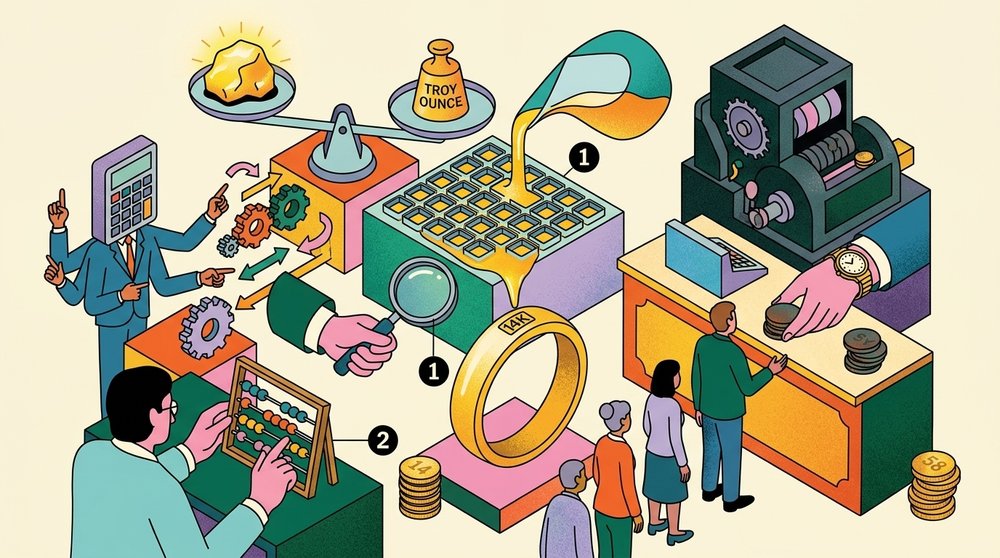
Three steps. Each one is a single division or multiplication.
Step 1: Convert spot to per-gram, pure. Gold spot is quoted per troy ounce. A troy ounce is 31.1035 grams. So:
pure gold per gram = spot price per troy ounce ÷ 31.1035
At $4,500/oz, pure gold is $4,500 ÷ 31.1035 = $144.69 per gram.
Step 2: Multiply by the karat fraction. 14K is 14 parts gold out of 24 parts total. That fraction is 14 ÷ 24 = 0.5833, usually written as 0.583 or 58.3%.
14K per gram = pure per gram × 0.583
So $144.69 × 0.583 = $84.36 per gram at $4,500/oz spot.
Step 3: Multiply by the weight in grams. A 6-gram 14K ring is worth 6 × $84.36 = $506 in melt.
That is the whole calculation. No asterisks attached. It is the number a refiner would pay if you walked in with a fresh-melted 14K bar and no markup attached.
A quick mental shortcut
If you are standing in a jewelry store and have no calculator handy, the rough math goes like this:
- A gram of 24K is roughly spot ÷ 31, or about 3.2% of the troy-ounce price.
- A gram of 14K is roughly spot ÷ 53, or about 1.9% of the troy-ounce price.
- A gram of 10K is roughly spot ÷ 75, or about 1.3% of the troy-ounce price.
So at $4,500/oz, a quick read is: 14K is about $4,500 ÷ 53 = $85 per gram. That is within a few cents of the precise answer, and you can do it in your head.
If you weigh the piece on a scale that reads in grams (which any kitchen or postal scale does, since they measure in avoirdupois ounces and grams, not troy ounces), you can ballpark the melt value at the counter in under thirty seconds.
The 14K per-gram price at common spot levels

Spot moves daily. Here is the per-gram 14K melt value across a range of recent and historical spot prices.
| Gold spot per troy ounce | Pure gold per gram | 14K per gram (melt) |
|---|---|---|
| $2,000 | $64.30 | $37.49 |
| $2,500 | $80.38 | $46.86 |
| $3,000 | $96.45 | $56.23 |
| $3,500 | $112.53 | $65.60 |
| $4,000 | $128.60 | $74.97 |
| $4,500 | $144.68 | $84.35 |
| $5,000 | $160.75 | $93.72 |
| $5,500 | $176.83 | $103.09 |
A few useful reference points pulled off that table:
- A standard plain 14K wedding band weighs around 4 to 7 grams. At $4,500 spot, the gold content is worth $337 to $590.
- A 14K rope chain that weighs 30 grams contains about $2,530 of gold at $4,500 spot.
- A 14K class ring at 10 grams runs about $844 in melt.
Those numbers are the gold content only. They ignore any gemstones, which most pawn shops and refiners will value at zero unless the stones are large and certified.
What you will actually be offered
The melt value is your reference point. It is not the price anyone in the secondary market is going to pay you for finished jewelry. Here is what the spread actually looks like.
Pawn shop. A pawn shop is buying for inventory turnover and has to cover overhead, theft risk, and the cost of capital. Typical offer is 30% to 60% of melt. For our 6-gram, $506-melt ring, expect somewhere between $150 and $300. If you accept the first offer, you are usually on the low end. If you mention you have a quote from another buyer, you usually move to the middle of the range.
Jewelry-store buyback. Some stores buy back gold for store credit or cash. Cash offers run 50% to 75% of melt. Store credit, which you spend on new jewelry at full retail markup, is often quoted at 80% to 100% of melt, but the markup on the new piece eats the difference.
Cash-for-gold mail-in services. The big national mail-in services typically offer 30% to 60% of melt and write the check based on the assay they do after you have already shipped the piece. Read the return-shipping policy before you seal the envelope.
Local refiner. If you live in a city with an independent precious-metals refiner, they pay closest to melt, usually 85% to 95%, minus an assay or refining fee. This is the highest realistic payout for unsentimental jewelry. You generally need to bring at least a few hundred dollars of melt value for it to be worth their time.
Private sale. If the piece is recognizable jewelry (a Tiffany ring, a vintage Cartier piece, a designer chain), private resale on a marketplace like eBay or a consignment platform can clear 70% to 120% of melt, because the design and brand carry value above the gold. For generic 14K, private sale rarely beats a refiner.
Before you walk in to sell
Three minutes of prep puts you in a much stronger position.
- Weigh the piece on a digital scale in grams. Kitchen scales work fine. A jeweler's loupe is not required.
- Check the karat stamp. Most U.S. jewelry is stamped inside the band or on the clasp. "14K," "585," and "14kt" all mean 14-karat. "585" is the European purity stamp for 58.5% gold, which is functionally the same as 14K. Anything stamped "GP," "GF," "RGP," or "1/20" is gold-plated or gold-filled and has near-zero melt value.
- Multiply weight × 0.583 × current per-gram pure price. That is your melt number. Walk in knowing it.
If the offer in front of you is less than 50% of that, push back or walk away. If it is 70% or more, you are getting close to what an independent refiner would pay.
Why karat-grade gold pricing belongs in your menu bar

If you trade, stack, or sell jewelry with any regularity, this calculation gets done often enough that having it pre-computed saves real time. Spot moves every day. The 14K price moves with it. Running the math by hand once is fine. Running it every Tuesday is not.
SpotBar shows live gold spot in your Mac or Windows menu bar, with karat-grade pricing built in on the Pro tier. Click the icon and you see the per-gram price at 24K, 22K, 18K, 14K, and 10K simultaneously. No spreadsheet, no calculator, no tab switching. The free version is gold-only and shows pure spot. Pro adds karat-grade gold, plus silver, platinum, and palladium, plus per-gram, per-tola, and per-kilo display for international buyers.
The data feed is the same wholesale source the rest of the bullion industry uses. Pricing refreshes hourly while markets are open. No account, no subscription, no telemetry inside the app.
Frequently asked questions

How much is 14K gold worth per gram right now?
At a gold spot price of $4,500 per troy ounce, 14K gold is worth approximately $84.36 per gram in pure melt value. The number scales linearly with spot. At $5,000/oz it is about $93.72 per gram, at $4,000/oz about $74.97. Always check the current spot price before pricing any specific piece.
What does 14K mean on a gold ring?
14K means 14 parts gold per 24 parts of total metal, or 58.3% gold by weight. The other 41.7% is alloy metal (usually copper, silver, zinc, or nickel) added to harden the gold so it can survive daily wear. A 14K ring stamped "585" means the same thing in European notation.
Why is 14K gold cheaper than 18K?
18K contains 75% gold by weight, while 14K contains 58.3%. There is more gold in an 18K piece of the same weight, so the melt value is higher. At $4,500/oz spot, an 18K gram is worth about $108.51, compared to $84.36 for 14K. 18K is also softer than 14K and shows wear faster, which is part of why 14K dominates the U.S. market.
Will a pawn shop give me melt value for 14K gold?
Almost never. Pawn shops typically pay 30% to 60% of melt value for generic 14K jewelry. They have to resell the piece or melt it themselves, and they have to cover overhead and the cost of capital, so the spread is large. A local refiner pays closest to melt, usually 85% to 95%, minus a small assay fee.
How do I tell if my jewelry is real 14K gold?
Look for a karat stamp inside the band, on the clasp, or under the post. "14K," "14kt," or "585" all indicate 14-karat gold. If the stamp says "GP," "GF," "RGP," "HGE," or "1/20," the piece is gold-plated or gold-filled and only carries a thin gold surface layer. A jeweler can also do a touchstone test, or use an XRF analyzer for a non-destructive purity reading.
Is 14K gold a good investment?
Generally no, in finished-jewelry form. The retail markup on new 14K jewelry runs 100% to 300% over melt, and the resale market only pays back a fraction of melt. If you want to invest in gold, bullion coins and bars trade at much narrower premiums (4% to 7% over spot for a 1 oz American Gold Eagle, for example) and resell at close to spot. Jewelry holds value as a sentimental and design object, not as a gold position.
How much does 14K gold cost per ounce?
At $4,500 per troy ounce of pure gold spot, 14K gold contains about $2,624 of gold per troy ounce of finished piece ($4,500 × 0.583). For everyday avoirdupois ounces, the kind your kitchen scale reads, the conversion factor is slightly different. See the grams-and-ounces conversion guide for the full breakdown.
What is the 585 stamp on gold jewelry?
"585" is the European purity stamp for 14K gold. It means the alloy is 58.5% pure gold by weight, which rounds to the same thing as the U.S. "14K" mark (14 ÷ 24 = 0.5833). European, German, and Italian gold jewelry is most often stamped 585 rather than 14K. The two stamps are interchangeable for valuation purposes.
The math is small enough to do at the counter. The trick is knowing it before you walk in, so the offer in front of you lands somewhere on the spread you understand instead of somewhere the buyer wants you to settle for.
Download SpotBar free for Mac or Windows to keep live spot in your menu bar, or grab Pro for karat-grade gold, plus silver, platinum, palladium, and four extra currencies.