 SpotBar

Silver Price Today: What an Ounce Is Actually Worth Right Now
When you search for "silver price today" your landing page will be almost completely filled with advertisements. There's likely an ad banner across the top of the page. On the right-hand side, there may also be a video that auto-plays as soon as you visit. In addition to the ads there are probably popup windows wanting to sell you a Silver Eagle. If you actually want to find out how much one ounce of silver costs today, you'll have to sift through all of this junk to find it, often buried in a very small font.
The most popular tracker search in the metals industry by volume is for silver, even more than for gold, and it's growing in usage from one year to the next. With all of its volatility and rapid movement compared to gold, people search "silver" on an ongoing basis. If you are new here, you should start with the gold price today post, since many of the concepts apply.
This article explains "spot price" in the context of silver, describes what causes the difference in movement between silver and gold prices, teaches you how to take a spot price and determine the actual cost to purchase the product, and provides the simplest method for keeping an eye on the live number with no advertisements.
What "silver price today" actually means
When a person states that "the price of silver is at $50" they are referring to the per-troy-ounce price of .999 pure silver in U.S. dollars within the global wholesale market. The number referred to as the price is known as the spot price, which is what dealers pay each other for silver delivered now.
Three related numbers surround this number. Mixing them up is how people get talked into bad deals.
- Spot price. The wholesale price right now. What dealers charge each other for one-ounce, ten-ounce, or thousand-ounce industrial bars.
- Futures price. What COMEX traders agree to pay for silver delivered next month or next quarter. Usually within a percent or two of spot.
- Retail price. What you pay at a coin shop or online dealer. Always higher than spot, and the percentage premium is bigger than on retail gold, because the underlying number is smaller.
Premiums broken down by product:
- A standard 1-oz American Silver Eagle typically runs 15–25% over spot
- A 100-oz industrial bar from a known refiner runs 5–10% over spot
- Sterling silver (.925) flatware or jewelry is priced by weight, usually 50–100% over melt
- Junk silver (pre-1965 U.S. dimes and quarters) sits 10–25% over melt depending on dealer
When you hear "silver is at $50," that represents the wholesale price. The American Silver Eagle in the case at your local coin store is likely to be priced between $58 and $62.
The LBMA Silver Price
The industry's reference price is the LBMA Silver Price, set once a day at 12:00 London time through an electronic auction among LBMA-accredited member banks. Unlike the gold fix, which has both a morning and an afternoon session, silver gets a single daily fix.
That figure is what gets used for ETF pricing, U.S. government reports, and most commercial silver contracts. The tick-by-tick prices that appear on Kitco.com or GoldPrice.org during market hours come from COMEX silver futures, not from the London Bullion Market Association.
A note on historical context
Silver has briefly traded above $50 per ounce only twice in modern history. The first time was in January 1980 when the Hunt Brothers attempted to corner the physical silver market and pushed prices to roughly $50 before regulators forced an unwind. The second time was in April 2011, when the post-financial-crisis monetary stress drove both gold and silver to new highs. For the majority of the past forty years, silver has traded within a range of approximately $5 to $30. Recognizing the historical band lets you tell a routine 5% move from a structural shift.
What moves the silver price
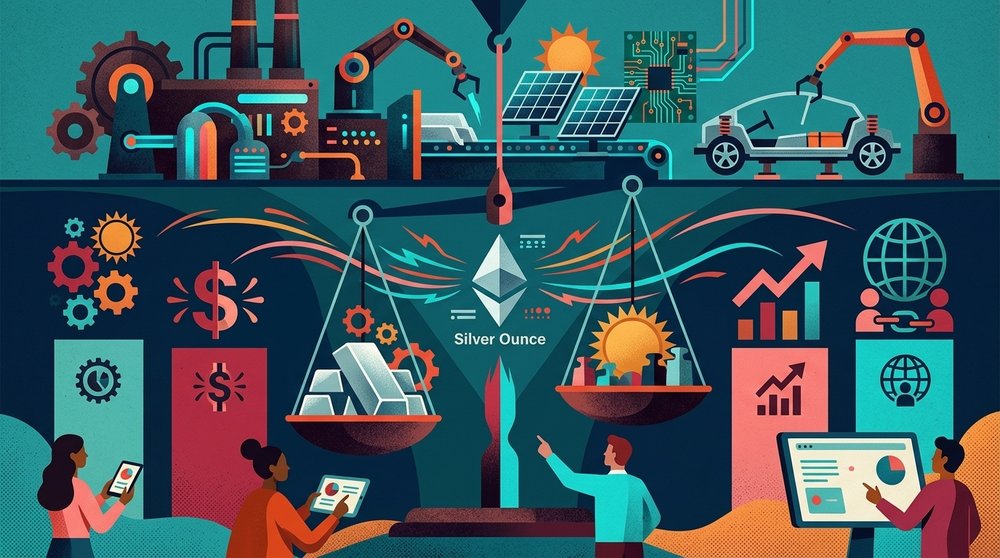
Silver and gold often correlate, but they move on different drivers. Four things matter most.
1. Industrial demand. Approximately fifty percent of all silver used annually is for industrial purposes such as solar panels, electronic components, electric vehicles, and medical products. Gold is primarily a monetary asset, but silver is a hybrid: a monetary metal and an industrial commodity at the same time. Thus, when industrial demand increases (especially for solar) silver gets bid up by buyers who don't need to consider the value of the U.S. dollar. The Silver Institute publishes annual demand estimates.
2. The gold-silver ratio. The price of one ounce of gold divided by the price of one ounce of silver. Historically this number has ranged from 50 to 80. When it goes above 80, silver is cheap compared to gold. When it falls below 50, silver is expensive compared to gold. Stackers watch the ratio for contrarian signals. See the gold-silver ratio post for the full long-form explanation.
3. The dollar and real rates. As with gold, silver tends to move inversely to the U.S. dollar (DXY) and to real interest rates (nominal yield minus inflation). The relationship has the same shape, just stronger. Silver reacts more sharply to changes in gold than gold itself does. For example, if gold increases by 5% during a quarter, silver typically increases at least 10% over the same time frame.
4. ETF and futures flows. The wholesale silver market is roughly one-tenth the size of the gold market by dollar value, so positioning moves it more. Big inflows to silver ETFs or short squeezes in COMEX silver futures can push silver several percent in a single day. This is why silver tends to be more volatile than gold even when the broader macroeconomic environment is unchanged.
If you only have time to watch one indicator, watch the gold-silver ratio. It tells you whether silver is being valued like a monetary metal or like an industrial commodity at any given moment.
Where to read the silver price (without the ads)

Your options, in order of how much friction stands between you and the number:
| source | accuracy | ads | account | always visible |
|---|---|---|---|---|
| Kitco web | great | yes (banner + popover) | optional | no, browser tab |
| GoldPrice.org | great | yes (heavy display ads) | no | no, browser tab |
| Bloomberg Terminal | best in class | no | yes ($24,000/yr) | yes |
| Native menu-bar app | great | depends on the app | no | yes |
Most users will be best served by a small native Mac or Windows application that displays the current price of silver in the menu bar. No tab switching. No popup asking you to buy silver immediately. Just a number that's there when you glance up.
That is what SpotBar does. SpotBar gets an hourly read of the spot price for silver and the other three major metals from a wholesale data feed during market hours and places that price in your menu bar. Clicking the menu item opens a richer popover with charts. There are no banner advertisements and no need to create an account. The gold-only version is free to download, and the Pro version unlocks silver, platinum, and palladium, plus per-gram and per-tola display.
Why hourly updates and not real-time tick-by-tick
Silver moves more than gold, but most readers don't need second-by-second information. When you are searching for "silver price today," you generally just want to know whether silver is at $48 or $52, not whether it's $50.13 or $50.18. Hourly is plenty.
SpotBar uses a wholesale aggregator's hourly update. It is much cheaper than real-time tick feeds, which run hundreds of dollars per month, and it is just as accurate to within a fraction of a percent. Those savings let SpotBar be a one-time purchase rather than a monthly subscription. If you genuinely need one-second silver ticks, you want a Bloomberg Terminal, not a $19.99 menu-bar app.
How to convert silver spot into the price you'd actually pay

Once you have spot, two additional steps will give you the cash value of what you have in your hand.
Per gram, per tola, per kilo
Silver's conventional pricing is in terms of troy ounces. A single troy ounce equals 31.1035 grams. Divide your spot price by 31.1035 to determine your price per gram. At $50 per ounce, for example, you would be paying approximately $1.61 per gram.
Other standard units:
- Gram = spot ÷ 31.1035
- Tola (used in India, Pakistan, the Middle East) = 11.6638 grams. At $50/oz that is roughly $18.78/tola.
- Kilo = spot × 32.1507 (1 kg = 32.1507 troy oz). At $50/oz that is roughly $1,608/kg.
Sterling silver and other purities
Pure silver in the form of bullion coins or bars is considered .999 fine, also known as three-nines fine. Sterling silver jewelry and flatware is generally .925, which means approximately 92.5% pure silver and 7.5% other metal (usually copper) added to improve the strength and hardness of the product. Some Mexican silver products run .950 or higher.
melt value = weight in grams × purity fraction × spot price per gram
Worked example: a 200-gram sterling silver tea set at $50 per ounce on the spot market.
200 × 0.925 × ($50 ÷ 31.1035) = 200 × 0.925 × $1.61 ≈ $298
A pawn shop will likely offer somewhere around $150 to $180. A precious-metals refiner could pay close to 90% of melt value, around $268. If your item weighs a lot, it's worth the trip.
Frequently asked questions

Why is silver more volatile than gold?
The total dollar value of the silver wholesale market is approximately 10 percent that of the gold market, with roughly half of annual demand being for industrial use. As such, big positions in silver can create large price movements, since there are fewer players in this smaller market. Daily price swings of 2 to 3 percent on silver are common, whereas a daily swing of 1 percent or less is normal for gold.
What is the gold-silver ratio and why does it matter?
It is the price of 1 ounce of gold divided by the price of 1 ounce of silver. For example, if gold is priced at $4,500 and silver at $50, the ratio is 90. Stackers use this ratio as a contrarian indicator. When the ratio rises above 80 it indicates that silver is under-priced relative to gold. When the ratio falls below 50 it indicates that silver is over-priced. Beyond short-term trading opportunities, the historical evidence suggests this ratio tends to revert toward its long-run average over time.
Is silver still a good inflation hedge?
It's a mix. Silver does rise with inflation, but its industrial side makes it just as sensitive to recession. When factories slow down, people sell silver even when there is inflation. Gold is the cleaner inflation hedge. Silver is the more volatile play, which can either outperform or underperform gold.
What is junk silver?
The term refers to coins made before 1965 (dimes, quarters, half-dollars) that contained 90 percent silver. These "junk" silver coins typically sell at a 10 to 25 percent premium over melt value and are popular with stackers because they represent tangible, divisible amounts of silver. A pre-1965 dime contains approximately 0.0723 troy ounces of silver. Therefore, at a $50/troy oz spot price, the dime carries roughly $3.62 worth of silver.
What's the purest form of silver?
Sterling silver (.925) is one of the most commonly encountered alloy types in jewelry and U.S. coins from before 1965. Another common type is coin silver (.900). Investment-grade silver runs .999 or higher: the American Silver Eagle from the U.S. Mint is .999 fine, the Canadian Silver Maple Leaf is .9999, and the Royal Canadian Mint produces a .99999 silver bar.
How do I sell silver without getting ripped off?
Calculate the melt value before you walk in. First, weigh your item in grams. Next, determine the purity fraction (0.999 for bullion, 0.925 for sterling, 0.900 for U.S. coins prior to 1965). Then multiply by the current per-gram spot price. The result is your floor, the minimum the metal alone is worth. Refiners typically pay 85 to 95% of melt for scrap. Pawn shops pay 50 to 70%, depending on the item. Jewelry stores fall somewhere in between, sometimes higher for branded pieces or rare coins. If you're offered less than half of melt, walk away.
Does SpotBar work for non-U.S. currencies and per-tola pricing?
Yes. On Pro, SpotBar supports USD (U.S. dollar), INR (Indian rupee), EUR (euro), GBP (British pound), and AED (UAE dirham). Display options include troy ounce, gram, tola, and kilogram. The free tier is gold-only in U.S. dollars. See the pricing page and the privacy policy. Nothing about your holdings ever leaves your device.
What happens to silver prices on weekends?
On weekends and U.S. holidays, when markets are closed, the spot price is frozen at the last close until markets reopen. SpotBar shows a "Markets closed" indicator in the popover during that window.
If you made it here looking for "silver price today," the easiest way to never have to come back is to download SpotBar for Mac or Windows. The Pro version unlocks live silver in your menu bar from then on. One glance, no tab switching, no advertisements.